Lienard-Wiechert potentials

The electric potential due to a  moving charge, even for one moving at near the speed of light, is given by the Lienard-Wiechert potentials.

To simplify reasoning, we take a cube-shaped charged particle, with each side length a, charge density ρ, travelling at speed v . The cube can be thought of as to have to travel through N sections or slices in space, each of thickness w.

The time for the ‘signal’ (which runs at the speed of light c) from the furthermost slice to the observer to catch up with that emitted from the nearest slice and thereafter travel together is :

time to catch up

In this time, a total of N slices have contributed to radiating from their positions. The total potentials from all the slices are :

Lienard-Wiechert potential

The expression for the vector potential is of a similar form.

If we had reasoned too simplistically, we would have thought that the potential was just :

wrong formula.png

And that would be wrong as it misses out on an important relativistic factor.

The wave equation

When sound waves propagate through air, the layers of air are subjected to mechanical disturbances. We can build up the wave equation by thinking carefully.

There are 3 interconnected quantity in a block of air that oscillate as sound waves travel through it : the displacement, the density and the pressure exerted on it. We can start the analysis with any one of these 3 quantities.

We’ll begin with pressure. As a block of air undergoes alternate compression and rarefaction, the pressure change causes an acceleration at each point :

Pressure-displacement

The changing pressure is brought on by a change in density :

Pressure-density

The density change is brought on by a displacement change, which was caused by the pressure change in the first place :

Density-displacement

Combining the three sets of equations and we obtain the wave equation :

wave equation

Sigma, Gamma and Lambda Matrices

Sigma matrices are the workhorses of Wolfgang Pauli. They are used to bring out the half-integer spin character of Fermi particles.

Sigma

Gamma matrices are Paul Dirac’s tools for formulating the wave mechanics equation of relativistic, massive, spin-half particles.

gamma

The 4 by 4 Alpha and Beta matrices relate the Gamma and Sigma matrices, but they are not named after any famous physicists.

alpha and beta

Gamma matrices may also be written in another manner called chiral representation (or Weyl representation), for working with left and right-handed spinors, instead of positive and negative energy spinors as in Dirac’s representation.

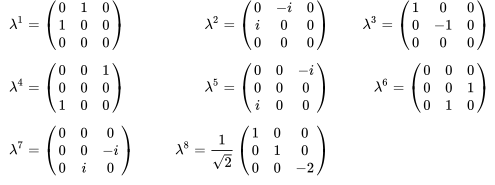
Lambda matrices are Murray Gell-Mann’s invention for the basis elements of the SU(3) group which is behind the Strong Force as predicted by quantum chromodynamics.

lambda

Feynman invented the slash notation to shorten some writing.

feynman slash

Equations of light polarisation

Polarisation of light occurs when there is a constant phase difference between the 2 mutually perpendicular components of its accompanying electric field vector.

Ex and Ey

Expanding the y-component, rearranging the terms, and applying the trigonometric Pythagorean identity, we obtain :

polarization ellipse

Except for certain special values of φ, the resulting equation is that of an oblique ellipse. Now we know how to transform from an oblique ellipse to a “righted” system, using the following transformation method :

rotated coordinates

Hence we can re-write our equation relating the E-field components using the above transformation method and obtain a “righted” ellipse.

Righted ellipse

That’s in the form of a standard ellipse equation, with the values of the semi-major and semi-minor axes given by a and b.

The “ellipticity” of the ellipse is measured by the ratio of a-b to a.

Defining the elliptically-polarised light wave as right-hand polarised or left-hand polarised is a matter of choice, and here we have an annoying inconsistency : the optical physicists’ convention is opposite to that of the particle physicists.

We adopt the particle physicists’ convention : looking towards the oncoming light, if the E-field vector rotates in a counter-clockwise direction, we’ll call it right-hand polarised.

Many interesting phenomena are the results of light polarisation, for example birefringence, optical activity and the glare of sunlight reflected off water surface.


The equations for the origin of refractive index

We learn in secondary school how refractive index is a ratio of the speed of light in vacuum to the speed in the medium; that light travels slower in a material medium than in vacuum. But we always wonder what make light know to which angle it must refract when it’s time to turn, and we are curious about how light know its way when it reaches an interface. There is the principle of least time by Fermat to offer an explanation. But this still leaves us wondering : by what mechanism in the material through which light travels is the path of light determined ?

Here we will look at some equations of Electromagnetism that offer a way to understand the mechanism that gives rise to the refractive index of the material.

Our microscopic model of an atom shall be that of electrons joined to the nucleus by spring-like attachments. This of course is just a picture that is only partially true, but useful for visualising and formulating our explanation.

The equation of motion of an oscillator is :

oscillation

If the electric field vector is sinusoidal, then so are the displacement of the oscillator and the induced dipole moment :

E-field, displacement and dipole moment

In material medium, the Polarisation vector, the polarisation charge density and the the current density are given as :

polarization.png

Now we bring out Maxwell’s equations applied to material medium :

Maxwell's equations

Taking the curl on the curl of E, and making all necessary substitutions using the rest of Maxwell’s equations, plus known identities of nabla operations, we arrive at :

E and P

We assume that the medium is isotropic, that the wave propagates
in the direction of z, and that the E-field and the P vector both only have components in the x-direction only.

E and P once more

One more assumption, which needs some correction later, is that P is directly proportional to E, and we finally arrive at a formula for the refractive index  :

refractive index squared

Three corrections to the above formulation will give a more accurate final formula.

Firstly, the polarisation is proportional to the local field, not to the incident field, so  we should have :

n with local field

A second improvement is to use the quantum mechanics version of polarisability, as remarked above.

Finally if the medium is made up of a mixture of different types of atoms each with its own polarisability, then the contribution due to each type of atoms is to be added to obtain the final total polarisability.


Euler played with this series to the 26th power !

How do we find the sum of this infinite series ?

sum(1:r2)

Leonhard Euler hit upon a brilliant idea and found it.

He thought about the zeros of the sine function, and since they are the zeros, maybe he can get the sine function factorised. Obviously it can’t be done this way :

sine factored wrongly

since it will not be a converging series.

But if we divide by x on both sides and do a little rearrangement of terms in each factor, things look more promising  :

sinx:x factorised

Now the Maclaurin’s series for the sine function is well-known, so we can equate :

Macalurin series

Comparing coefficients for xon both sides, he found :

sum(1:i2)

It was a moment of great triumph for Euler. But our Swiss genius didn’t stop to admire himself, he pushed on to play with his series to make further calculations up to power 26 ! Here are some other results he discovered :

other sums

The even powers have all been conquered. But what about the odd powers. If anybody has found a formula for them, please share the result with everyone, since this is still a big mystery to this day.